
Trigger Warning: Suicide and suicidal ideation
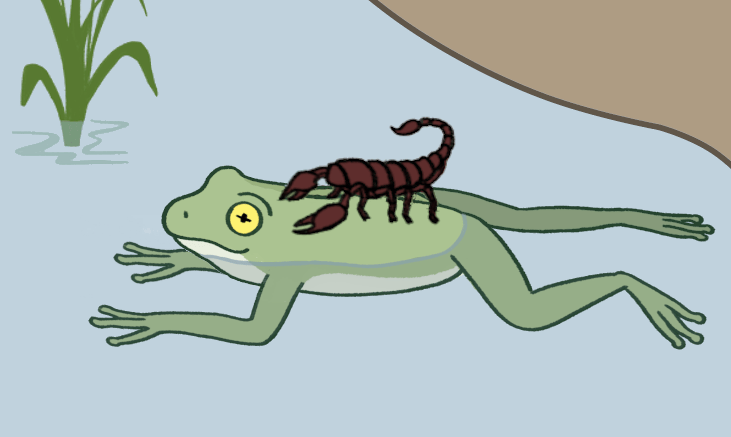
The sad tale of ‘The Scorpion and the Frog’. Image source: wikipedia
September is National Suicide Awareness Month (in the US, but I’m choosing to adopt it for the UK). This is the third in a set of 4 attempts to bust some of the key myths about suicide – and offer some advice about what to do instead.
Today we are looking at the myths around motivation and causality – myths that can be equally damaging and dismissive.
The narrative around suicide and suicidal ideation is often that there is usually a simple set of reasons that might trigger these thoughts and/or actions – probably most commonly poor mental health – but also factors including trauma or some form of genetic disposition.
According to Mind, common causes for suicidal ideation can include:
- Mental health problems*
- Physical health problems, including chronic pain
- Problems with work, including work stress, redundancy or not being able to find a job
- Problems in relationships, including break-ups and issues with family or friends
- Experiences of prison or the criminal justice system
- Abuse
- Experiences of discrimination, stigma or hate
- Housing problems, including homelessness
- Drug and alcohol addiction
- Trauma, including trauma from experiences in childhood
- Loneliness
- Social pressure, such as people making you feel like you need to do certain things or act in a certain way
- Shame, such as feeling like you haven’t achieved what was expected of you
- Bereavement, including losing a loved one to suicide
- Money problems
- Not being able to get mental health support or other support you might need
A few important notes about the above list:
- It is nowhere near exhaustive – another informing cause can be reactions to medication (including – occasionally – those prescribed to help with depression and anxiety – always speak to your GP if you have any concerns).
- There is some evidence that there can be an inherited (genetic) disposition towards suicidal ideation, but rigorous academic study into this is still in relative infancy, (see the below quote from Dr Hilary Coon).
- (*) Studies suggest that over 50% of those who have sadly died by suicide had no diagnosable mental health disorder (Nami).
- Few, if any, risk factors on the list above can truly be said to be simple, and certainly none are easily solved or even mitigated against in the short term. Likewise, our capacity to recognise or control these factors can vary wildly. Please never shame anyone for the difficulties they face.
- As with all risk factors, the more of the above you are wrestling with at the same time, the more enhanced your risk of suicidal ideation – have a quick think about friends and family who may be racking exposure to risk, and check in on them.
Linked to the above (set of) idea(s), a commonly held belief is that if someone feels suicidal now they will always be suicidal. There is also significant confusion about how any history of suicidal attempt may inform future behaviour – anecdotally I have heard strongly voiced statements suggesting someone surviving an attempt is somehow almost certain to try again and be too scared to even contemplate it in the future.
The reality is that people who experience suicidal ideation do so in a wide range of ways – for some it is a brief but powerful set of intrusive thoughts while others may experience persistent ideation over a much longer period of time. An attempt, or even realising just how strong a compulsion feels, may be enough to drive the urges away. Or maybe not. Either way, there are skills and strategies that can help – please talk to someone if you are struggling.
Along with this gross oversimplification behind the drive to think or act in such a desperate way is an equally damaging and dangerous set of beliefs – dangerous because they can stop someone from honestly sharing how they feel and/or from being taken seriously.
You will have heard most of the following: Those expressing suicidal ideation are…
- Attention seeking
- Weak
- Cowardly
- Selfish
- Lazy
- Seeking death
- Out for revenge
All of the above are inaccurate and unlikely to be the whole story. If someone wants your attention, please find time and energy to give it to them. You may well struggle to understand or empathise – but remember that everyone experiences things differently to those around them, and may be dealing with more than you are aware of.
The majority of people who feel suicidal do not actually want to die – but may be overwhelmed with things that seem to heavy to carry. They want things to stop, they want to rest, they want to take a breath and think about things more clearly and rationally. But don’t know how that can happen. The idea that suicidal action is based in revenge has some traction, but it is incredibly rare that such occurrences are intended as acts of revenge or aggression – again, it is often a sadly desperate attempt at ending pain and distress.
What can I do?
- Always take someone seriously if they confide that they are struggling with suicidal ideation.
- Thank them for being honest and brave enough to share with you
- Ask them how often they feel this way
- Ask if they have made any plans, or taken any actions
- Encourage them to speak to their GP, and – if appropriate – help them make an appointment. Consider helping them get to an A&E or equivalent if you are worried.
- If appropriate, help them understand the weights they carry – not to explain any burden away dismissively, but rather to help them give themselves permission to feel how they do – but also to recognise the need to act to mitigate these feelings.
- Don’t overpromise.
- Don’t be afraid to get in touch with one of the following organisations for more help:
Mind support line
0300 102 1234 – open 9am to 6pm, Monday to Friday (except bank holidays).
Samaritans
Call 116 123 (free from any phone) – 24 hours a day, 365 days a year.
SANEline
0300 304 7000 – 4.30pm – 10pm every day.
National Suicide Prevention Helpline UK
0800 689 5652 – 6pm to midnight every day.
Campaign Against Living Miserably (CALM)
0800 58 58 58 – 5pm – midnight every day. You can also use the CALM webchat service.
Shout
If you would prefer not to talk but want some mental health support, text SHOUT to 85258.
Papyrus HOPELINEUK
If you’re under 35, call 0800 068 4141 – 24 hours, 7 days a week. You can also email pat@papyrus-uk.org or text on 07786 209 697.
Switchboard
If you identify as gay, lesbian, bisexual or transgender, call 0300 330 0630 – 10am – 10pm, every day. There is also a chat service.
Helplines Partnership
For more options, visit the Helplines Partnership website for a directory of UK helplines. If you’re outside the UK, the Befrienders Worldwide website has a tool to search by country for emotional support helplines around the world.
Other Myths in the series:
Myth 1: “Only certain types of people have suicidal ideas”
Myth 2: “You just never know…” and “these are the things to watch out for that definitely mean…” if someone is feeling suicidal and/or has plans.
Myth 4: “You must never talk to someone about suicide“
A postscript: “Post suicide awareness, erm, awareness”


 Qawah Life Coaching
4 thoughts on “Suicide Awareness Month: Monday Myths #3”